A Woman's Right to Choose
Women have always terminated pregnancies, a practice that only became illegal in America in the late 19th century. Outlawing this procedure did not make it go away, however. Instead, the enterprise moved underground. Throughout much of the 20th century, abortion laws remain repressive. Women have few options and are at the mercy of a black market. Back-alley abortions are expensive, legally risky, and medically dangerous — but not uncommon.
Now the second wave of feminism is underway. Women are organizing and fighting for their rights. This is the era of the Equal Rights Amendment, health-care collectives, and consciousness-raising. It is in this climate that the Supreme Court strikes down all state laws criminalizing abortion. In 1965, a Connecticut statute outlawing contraception and the dissemination of information about preventing pregnancy was ruled unconstitutional in Griswold v. Connecticut. The Court relied on the constitutionally mandated "right of privacy" to strike down the law. This argument proves critical in the 1972 case, Eisenstadt v. Baird, in which the Court decides that the Massachusetts legislation allowing only doctors and druggists to distribute contraceptives — and only to married women — doesn't pass constitutional muster. In Roe v. Wade, the 1973 watershed decision, the Court rules seven to two that terminating a pregnancy is a private decision between a woman and her doctor. Abortions can now be legally performed and obtained. But the controversy isn't over. Less than ten years later, this decision will be under a full-fledged attack that will endure into the next century.
|
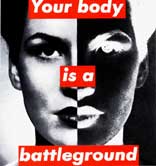
| Untitled Barbara Kruger, 1989 |