Prison Privatization
The prison boom strains public resources. Jurisdictions have already begun hiring private corporations to provide services, from food to healthcare, for correctional institutions. Perhaps it is inevitable that private industry eventually should provide actual prison space as well. Some people argue that corporations are better equipped to do what the government does incompetently and at an inflated price. Others account for the trend by pointing to ideological shifts toward promoting smaller government and increased reliance on the private sector.
In order to win the contract to run a prison, a corporation's bid must be lower than the government's costs for running the enterprise. It must do everything cheaper — and turn a profit for shareholders. Hiring nonunion labor, offering few inmate programs, and reducing staff training are among the cost-cutting strategies employed.
Many complex and important questions arise when punishment practices are turned over to the private sector. When the system fails, is the government responsible or the corporation? Must corporations abide by court-mandated minimum standards? What type of oversight is appropriate or necessary? Is it morally justifiable for punishment to be a profit industry? Are these operations really saving money? A crowded institution will generate more money than an empty one; will private companies try hard enough to rehabilitate prisoners so they return to the outside?
By the mid 1990s, the two largest private prison corporations, the Corrections Corporation of America and Wakenhut, have such high performing stock that they appear in many investors' portfolios. The controversies will remain unresolved.
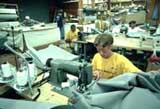 |
| Inmates work for Gold Coast, private company- work, earn, save and pay room and board to state. Ventura, Ca. Alon Reininger, 1996 |