Reading Is Fundamental: Benefit of Clergy
In the Middle Ages in Europe, a priest accused of a crime could claim the privilege of his status and have his trial transferred to ecclesiastical courts, which were significantly more lenient. To prove that he was a priest, he would have to show that he could readçno layman would know how. By around 1600, this "benefit of clergy" has come to protect anyone who can read. Instead of resulting in a transfer to a different court, it allows the person to receive a lesser punishment, often branding with a hot iron on the thumb. This literacy test becomes quite ritualized, and the Bible is always opened to the Book of Psalms, verse 51. This comes to be known as the "neck verse," because it can save readers from the gallows. Records show that colonists utilize the custom fairly often. In 1732, Virginia begins to allow women and slaves to claim benefit of clergy; Englishwomen had been granted this right in 1700.
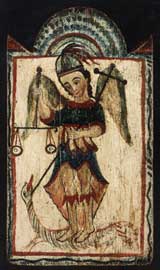 |
| Saint Michael, Retablo Jose Rafael Aragon, c.1830 |