Shame on You
Communities within colonies are remarkably small and close-knit. They are, in a sense, self-policing. People watch, monitor, and report on the behavior of their neighbors. When a crime is committed, everybody knows about it. Although those who have property may be fined, few people found guilty at trial can avoid public corporal punishment of some kind. Sentences include banishment, the wearing of placards that announce the crime, confinement in stocks or the pillory, mock executions, the wearing of patches (such as a scarlet A, for adultery), branding, whipping, and ear lopping.
It is believed that public shame and humiliation teach a moral lesson and prevent future offenses. A person in the stocks faces family, friends, and congregation members. Observers are expected to express their scorn and condemnation, and they often abuse the offender not only verbally but physically, by throwing rocks. The shame this evokes is supposed to lead to repentance; confessions during punishment are not uncommon. In the end, however, the goal is to return the repentant offender to the community. One does not cease to be a valued member merely because of a criminal act.
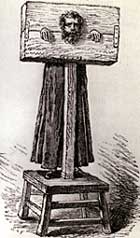 |
| An American Pillory |