Free Will & Deterrence
Cesare Beccaria's 1764 book, On Crimes and Punishments (see 1607-1776), finds an eager audience in America. He applied the ideals of the Enlightenment — reason, equality, and utility — to the issues of crime and punishment. According to his model, understanding criminality is directly related to the strategy used to combat it. It should be possible to deter criminals by making sure the punishment, or cost, outweighs the crime, or benefit.
Corporal punishments, with their reliance on pain and public humiliation, cannot be adapted to this equation very effectively. How can they be scaled up or down to match particular crimes? There may not be a significant difference in the pain inflicted by 8 strokes with a whip as opposed to 11. And shame isn't felt in gradations; a person is either ashamed or not. Another problem is that the rich often buy their way out of punishment by paying a fine instead. Prison, Beccaria asserts, solves these problems. It is a great equalizer, a rich man's year in prison is the same as a poor one's — 12 months is after all 12 months. Time can be added or subtracted to a sentence to make sure the specific punishment fits the crime. The punishment is related to the offense, not the offender. It is widely thought that the prison will eradicate crime. Now that liberty is guaranteed, it is assumed that the rational man, acting of free will, would never forfeit his right to it.
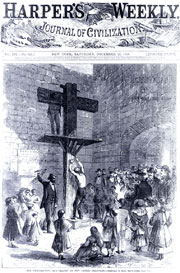 |
| The Whipping-Post and Pillory at New Castle Delaware, From Harper's Weekly, 1868 |