Behind Closed Doors
Punishment is becoming a private event, administered behind walls to hide it from public view. Public corporal punishments will soon be obsolete. The penitentiary doesn't address capital punishment, though. At the beginning of this era, executions are still rowdy, well-attended events. Hanging can take a long time and be quite gruesome.
But the new republic's new principles of reason and discipline soon conflict with the crude rituals of capital punishment. Executions come to be seen as vulgar, possibly even arousing the urge to criminal behavior. The body and its functions are becoming more private, and the spectacle of capital punishment becomes offensive to "civilized" sensibilities. Fear of the mob is a concern, as well as the effect on children of watching such an event. The first nonpublic execution takes place in 1834. New York prohibits public executions the next year, and by 1845 all capital punishment is administered inside a prison or jail. Ironically, an anti-execution movement that promoted some of these arguments in hopes of ending capital punishment altogether never anticipated the move indoors.
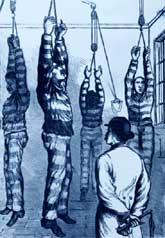 |
| "The Trapeze," a torture of hanging by the thumbs. Prison life in America, 1871 |