Separate but Equal
Under an 1890 Louisiana statute, any railroad passenger who enters a part of the train "to which by race he does not belong," can be found criminally liable and thereby fined. Two years later, Homer Plessy, who is traveling from New Orleans to Covington, Kentucky, buys a first-class ticket on the East Louisiana Railway. When he attempts to take his seat in an all-white compartment, he is arrested and jailed. Plessy claims that the law violates his 13th and 14th amendment rights, and is therefore unconstitutional. The Supreme Court does not agree. On May 18, 1896, in an eight-to-one decision, the court rules that "equal but separate" accommodations do not violate an individual's constitutional rights. The Louisiana statute and those like it pass constitutional muster. In upholding what has become known as the separate-but-equal doctrine, Plessy v. Ferguson enshrines Jim Crow for the next seven decades.
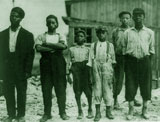 |
| Six black workers in the Alexandria (Va.) Glass Factory. Lewis Hine, photographer. 1911 Fogg Museum, Harvard University |